
Why Your Best Analysts Spend Earnings Season Formatting, Not Forecasting
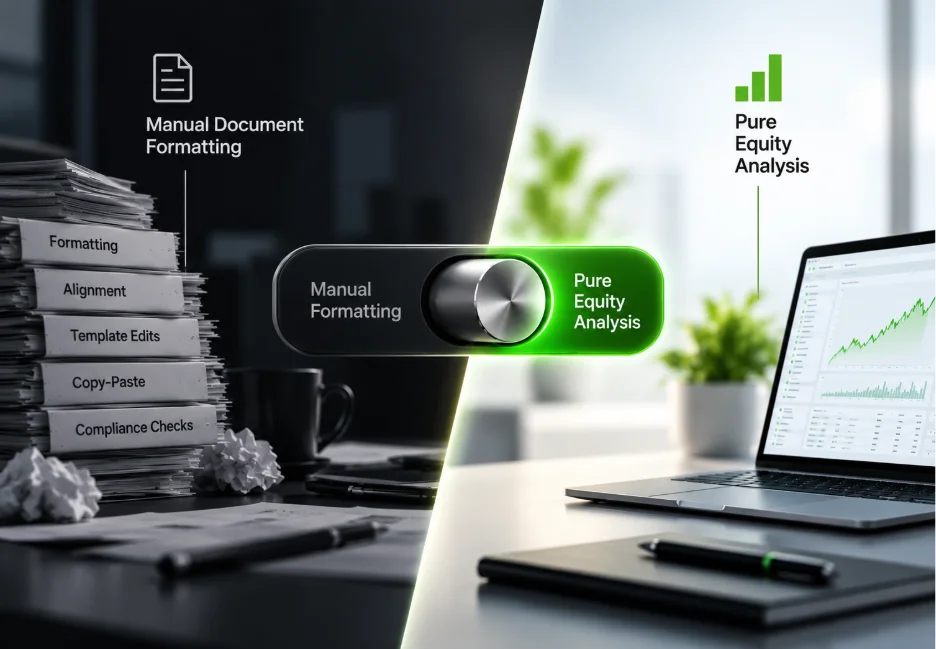
An equity research analyst may revise a company's earnings forecast in minutes, only to spend considerably longer updating the tables, charts, and documents that communicate those changes.
During earnings season, the challenge is not simply analysing quarterly results. It is ensuring that every revised estimate appears consistently across financial models, valuation tables, research commentary, and published reports.
When financial models, report templates, and publication workflows are disconnected, analysts become the manual link between updated forecasts and the research their clients receive.
That creates avoidable work precisely when analytical judgment and timely communication matter most.
Why Does Earnings Season Put Equity Research Teams Under So Much Pressure?
Earnings season creates concentrated workloads because several companies within an analyst's coverage universe may announce results within days.
Sell-side equity research teams must compare reported earnings against market expectations, revise assumptions, update valuations, and assess whether the investment thesis has changed.
At the same time, equity sales and trading professionals need approved research to support institutional client conversations. Buy-side clients expect timely explanations of earnings surprises and their implications for future performance.
The pressure comes from managing these responsibilities simultaneously without compromising research quality.
What Tasks Take Equity Research Analysts Away From Forecasting?
Financial modelling and forecasting involve developing assumptions, projecting company performance, and testing alternative scenarios. These are central analytical responsibilities.
The avoidable burden begins when analysts repeatedly transfer those outputs into research documents and prepare them for publication.
These tasks support research production. They become inefficient when fragmented processes require the same information to be handled repeatedly.
How Do Manual Earnings-Season Workflows Affect Research Quality and Productivity?
Manual workflows can consume analytical capacity and create additional opportunities for inconsistencies, particularly when earnings estimates change close to publication.
Consider an analyst revising revenue growth assumptions after a company's quarterly results exceed expectations.
The revised forecast affects projected earnings, valuation calculations, financial tables, charts, and potentially the investment recommendation.
Updating the model is necessary analytical work. Manually transferring the revised outputs into several documents, checking outdated figures, and correcting inconsistent formatting is the additional production burden.
A late-stage revision can also trigger another round of checks before publication.
For research houses, these delays affect more than internal productivity. They can reduce the time available for deeper scenario analysis, client discussions, and timely delivery of investment insights.
How Can Equity Research Teams Reduce Manual Work During Earnings Season?
Research teams can improve earnings-season productivity by identifying where information is repeatedly entered, reformatted, or reconciled.
A practical starting point is to examine a small sample of recently published earnings updates.
Ask three questions:
- How many tables, charts, and documents required manual changes after a forecast revision?
- Where did figures require repeated verification because multiple versions existed?
- How much time was spent preparing or correcting documents versus awaiting necessary approvals?
This distinction matters. Reducing analyst preparation time is different from shortening the approval process.
Research houses can then prioritize standardized report templates, controlled financial data, reusable content, and clearer publication responsibilities.
Coordination with equity sales should focus on delivering approved research efficiently, subject to publication controls and research-independence policies.
The objective is to eliminate unnecessary duplication while preserving financial analysis, validation, and compliance oversight.
How Can ANALEC Resonate Help Equity Research Teams Manage Earnings-Season Workflows?
ANALEC Resonate is an investment research authoring, workflow management, and distribution platform designed to address operational challenges throughout the research publication process.
Its capabilities are particularly relevant when repeated revisions create additional document preparation and approval work.
Research authoring and formatting: Resonate provides Microsoft Office-based authoring tools, customizable research templates, and charting and formatting capabilities. These support consistent presentation of financial tables and exhibits, reducing the need to repeatedly prepare document layouts.
Centralized financial information: Its central repository supports financial estimates and valuation data that can populate research templates. This helps connect financial inputs with published research, while analysts remain responsible for validating assumptions and forecasts.
Workflow and compliance controls: Configurable approval stages, disclosure management, and audit trails provide visibility into document status, review responsibilities, and publication history.
Research distribution and engagement: Resonate supports preference-based distribution, branded emails, delivery to third-party aggregators, and readership analytics. Once research is approved, these capabilities support controlled delivery and help sales teams understand client engagement.
Together, these features address repetitive work across research preparation, approval, and delivery. Their practical impact depends on implementation, data quality, and alignment with existing research processes.
What Should Research Houses Look for in Earnings-Season Research Technology?
The most useful equity research software should demonstrate how it handles an actual earnings-update workflow, not simply offer a long feature list.
Research leaders should assess whether a platform can:
- Support existing financial models and standardized report formats.
- Maintain clear distinctions between draft and approved financial information.
- Reduce repeated data transfer and document formatting.
- Preserve review controls, access permissions, and audit trails.
- Handle concentrated publication volumes during earnings season.
- Deliver approved research through appropriate distribution channels.
A useful vendor evaluation is to follow one revised earnings estimate from the financial model into a research report, through required approvals, and finally to client distribution.
This exposes integration limitations and manual interventions that feature demonstrations may overlook.
How Can Analysts Spend More Time Forecasting and Less Time Formatting?
The value of an equity research analyst lies in interpreting results, challenging assumptions, refining forecasts, and communicating investment insights.
Research report formatting, reconciliation, and publication controls remain essential. But these processes should support analytical work rather than repeatedly interrupt it.
For research houses seeking to improve earnings-season workflows, explore ANALEC Resonate to see how its research authoring, financial data management, workflow controls, and distribution capabilities can reduce operational friction while preserving research quality.
FAQs
1. Why do equity research analysts spend so much time formatting reports during earnings season?
Equity research analysts often need to update financial tables, charts, valuation figures, and report layouts after quarterly earnings announcements. When financial models and research documents are not properly connected, these updates require repeated manual work. This can reduce the time analysts have available for financial modelling, forecasting, and deeper investment analysis.
2. How can equity research analysts save time during earnings season?
Analysts can save time by using standardized research templates, maintaining centralized financial estimates, reducing manual data transfers, and improving research publication workflows. These practices help minimize repetitive formatting and reconciliation tasks while preserving the accuracy and review standards required in sell-side equity research.
3. What are the biggest challenges in the sell-side equity research workflow during earnings season?
The biggest challenges include managing multiple earnings announcements, revising financial forecasts, maintaining consistency across research documents, and meeting tight publication deadlines. Fragmented systems can increase these pressures by requiring analysts to manually transfer information between spreadsheets, reports, and publishing platforms.
4. How can ANALEC Resonate improve equity research productivity?
ANALEC Resonate supports equity research productivity through Microsoft Office-based authoring tools, customizable report templates, centralized financial estimates, and research workflow management. Its publication approval, compliance, and distribution capabilities can help reduce repetitive production tasks, allowing analysts to focus more attention on financial analysis and investment insights.
5. What should research houses consider when choosing equity research software?
Research houses should evaluate how well equity research software integrates with existing financial models, supports consistent report preparation, manages financial data, and maintains compliance controls. They should also assess publication workflows, scalability during earnings season, and ease of adoption. A practical evaluation should test how a revised financial forecast moves through report preparation, approval, and client distribution.