
Beyond the Attachment: Why Visual Research Emails Can Drive Stronger Client Engagement
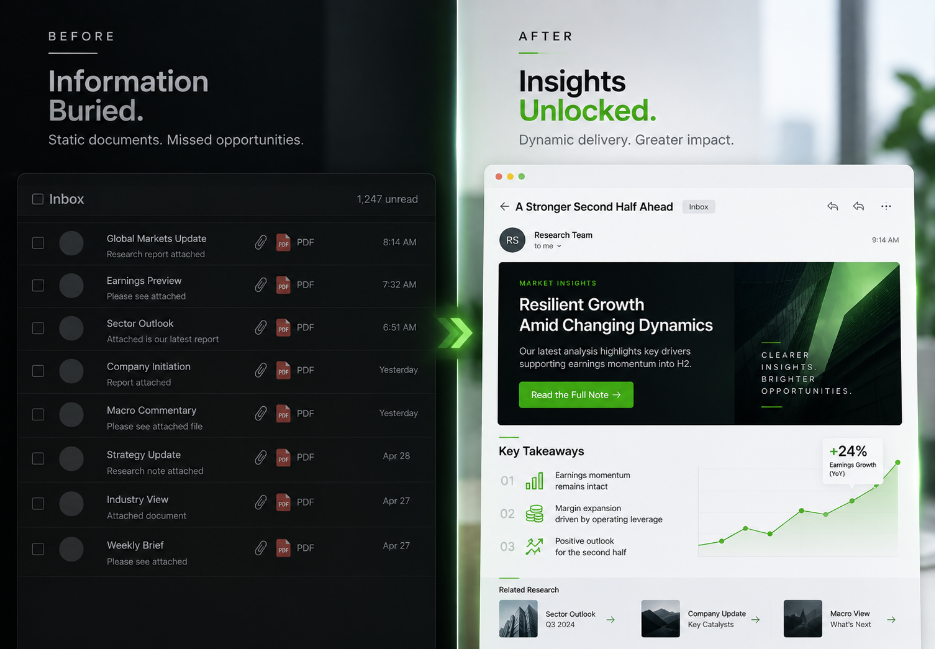
Before the market opens, a portfolio manager may scan a dozen company-result notes, sector updates and rating changes across a crowded inbox. Most will have required hours of analyst work before they ever reached that point.
Models were updated. Numbers were checked. Commentary was drafted and edited. Compliance reviewed the content. Disclosures were applied. The note moved through workflow and reached final approval.
At that moment, most of the cost has already been incurred.
What happens next determines whether the research desk gets enough commercial value from that investment.
A research email is therefore not simply a distribution vehicle. It is the point where research production starts becoming measurable client consumption and where a research director begins to understand whether the firm is publishing what clients actually value.
PDF-Only Distribution Hides the Economics of Research
There is nothing inherently wrong with PDF research. Institutional clients still need the complete note, supporting analysis, valuation work and disclosures.
The problem begins when distribution intelligence stops at “sent.”
What Does a Research Desk Actually Know After Distribution?
A desk may know that an earnings note went to 400 recipients. That says almost nothing about its commercial reach.
Did recipients engage? Did they consume the note through HTML or PDF? Which research generated repeat readership? Which analyst’s coverage consistently attracted attention from important accounts?
Without that signal, a large part of research management remains based on anecdotal feedback, sales recollection and relationship memory.
That becomes harder to defend in a market shaped by MiFID II unbundling, pressure on research budgets and increasingly explicit scrutiny of what institutional clients are willing to pay for.
The relevant question for a Head of Research is no longer simply, “Did we publish?”
It is, “Was this research consumed by the clients whose vote and commission allocation matter to us?”
Visual Research Emails Make the First Interaction Measurable
Visual email matters, but not because charts make research look more modern.
Its value is that it moves part of the research proposition into the body of the communication, where a client can assess relevance immediately and where engagement can begin to generate a signal.
Why Does the Email Body Matter?
A company-results email, for example, might surface the analyst’s conclusion, the earnings variance that matters, a key valuation observation and a clear route into the full research note.
That gives the portfolio manager enough context to decide whether deeper reading is worthwhile without weakening the underlying analysis.
For the research desk, the important consequence is measurable behaviour.
Branded responsive emails, trackable links and the ability to monitor research consumption create a clearer picture of what happens after publication. ANALEC Resonate also supports distribution through PDF and HTML and can track readership patterns across individual recipients and institutions.
The distinction matters. Engagement data is not useful because it produces another dashboard. It is useful because it adds evidence to decisions about coverage, client service and research resource allocation.
Readership Data Changes the Coverage Conversation
Research houses routinely face uncomfortable allocation decisions.
A senior analyst may cover a respected franchise with expensive maintenance requirements but limited measurable readership. Another analyst may cover a less prestigious sector that consistently attracts attention from high-value institutional accounts.
Without consumption intelligence, both situations can look similar from inside the research department.
Which Coverage Is Actually Earning Client Attention?
Readership data gives management another lens.
It can help answer practical questions:
- Which analysts are being read consistently?
- Which sectors attract attention from priority accounts?
- Which research products generate repeat consumption?
- Do clients prefer HTML or PDF delivery?
- Which notes attract interest but fail to generate deeper engagement?
- Where is research effort producing little observable client response?
None of these measures replaces broker vote, sales feedback or direct client conversations. Institutional research economics are too relationship-driven for that.
But they make those conversations better informed.
When research directors enter budget reviews, coverage discussions or broker vote preparation, they have something more useful than publication volume. They have evidence of consumption.
Research Distribution Should Feed the Commercial Loop
The operational mistake is to treat publication as the end of the research workflow.
It is not.
Final approval should trigger a second process: distribution, readership capture and feedback into future coverage decisions.
How Does Resonate Connect Distribution With Commercial Intelligence?
Resonate is built around that broader research lifecycle. Alongside workflow and compliance controls, it supports branded research distribution, individual client preferences, readership intelligence and delivery to third-party aggregators using RIXML.
That creates a stronger connection between the production side of research and the client-facing side.
A research director can begin to see not only what the desk produced, but what the market actually consumed. Equity sales teams gain better evidence for follow-up. Research analysts gain a clearer sense of which content resonates with clients. Management gets a more defensible basis for allocating scarce analyst capacity.
This is where research technology becomes commercially relevant.
The objective is not simply to distribute more content. It is to recover more value from content the firm has already paid to produce.
Cost-to-Publish Is Fixed. Cost-per-Note-Read Is Not.
Every research note carries a cost before it reaches a client: analyst time, model maintenance, editorial effort, compliance oversight and distribution infrastructure.
Once approved, much of that cost is sunk.
Which Metric Can a Research Director Still Influence?
What the research organization can still influence is how effectively that note reaches the right clients, how easily they engage with it and how much intelligence the firm captures from that consumption.
That changes the management metric.
Research desks already understand cost-to-publish. The more revealing number is cost per note read, especially among the accounts that matter commercially.
A PDF attachment may still be part of the answer. But distribution that ends with an attachment leaves too much of the research P&L invisible.
ANALEC Resonate gives research organizations a way to connect publication, digital distribution and readership intelligence more closely, so the value of research can be judged not only by what was produced, but by who actually consumed it.
FAQs
1. What are visual research emails in equity research?
Visual research emails surface the most important parts of a research note directly in the email, such as the analyst’s conclusion, key financial data, selected charts and links to the full note. They help clients assess relevance quickly without replacing the depth of the underlying research.
2. Why is PDF-only research distribution a limitation?
The issue is not the PDF itself. The limitation is that distribution can stop at “sent,” leaving research teams with little insight into what happened next. Without readership intelligence, it is harder to know which clients engaged, what formats they preferred and which research attracted meaningful attention.
3. Why does readership data matter to research directors?
Readership data gives Heads of Research another evidence base for coverage and resource-allocation decisions. It helps show which analysts, sectors and research products are being consumed by priority accounts, rather than relying only on publication volume, sales recollection or anecdotal feedback.
4. How does research consumption data support broker vote and commission discussions?
Consumption data does not replace broker vote, sales feedback or direct client relationships. It adds another signal by showing which research is actually being read by commercially important clients, helping research leaders make more informed decisions about coverage priorities and research investment.
5. How does ANALEC Resonate support research distribution and engagement?
ANALEC Resonate connects research publication with digital distribution and readership intelligence. It supports branded research emails, PDF and HTML delivery, client research preferences, readership tracking and distribution to third-party aggregators using RIXML, helping research organizations understand not just what they publish, but what clients consume.