
Why Pre-Built Research Templates Matter for Brand Consistency and Speed
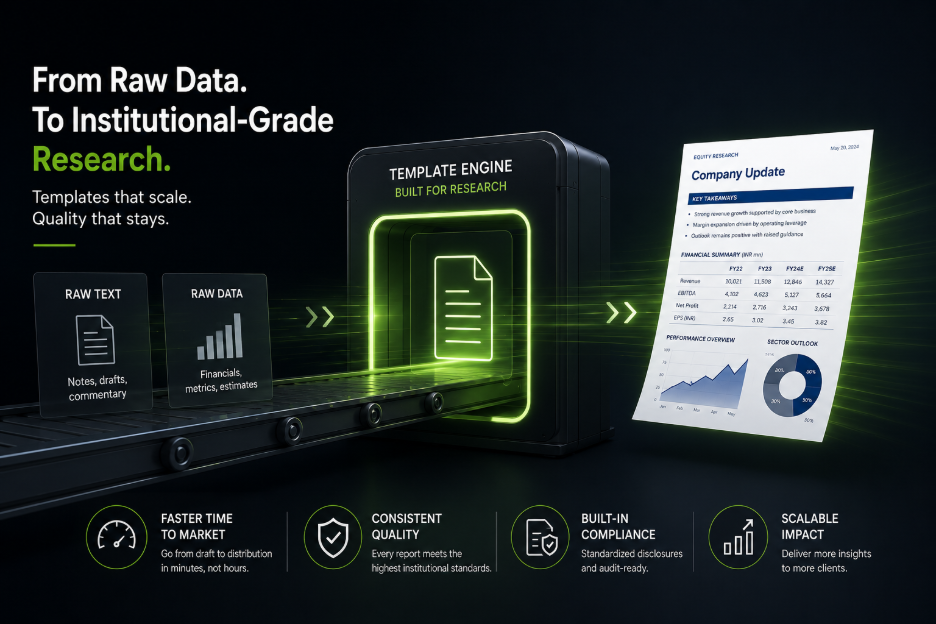
Research teams are under pressure from both sides of the desk. Clients expect equity research reports to arrive faster, look polished, and feel consistent across every interaction. Internally, firms need stronger control over disclosures, approvals, and publishing standards.
That creates a familiar problem in many research organizations. Analysts are expected to produce differentiated investment thinking, yet too much time still disappears into formatting, reworking layouts, fixing tables, and checking whether standard language has been inserted correctly.
That is why pre-built research templates have become increasingly important. They help research teams improve publishing speed, protect brand consistency, and reduce avoidable process risk across earnings updates, initiation reports, rating change notes, morning research packs, sector reports, and fixed income notes.
Why Are Pre-Built Research Templates Becoming Essential in Equity Research?
Templates are no longer just a convenience. They have become part of how modern institutional research teams operate.
Why Is Speed Now a Publishing Requirement Rather Than a Nice-to-Have?
When markets move, firms need to publish quickly. Delays in formatting or document preparation can slow down the release of research at exactly the wrong moment.
In practice, that means research workflow design matters as much as research output. A good process should help teams move faster without creating new control issues.
Why Does Standardization Matter More as Research Volume Grows?
As firms publish across sectors, asset classes, and geographies, inconsistency becomes harder to manage. One analyst may structure an initiation report one way, while another formats a rating change note differently. Over time, that creates uneven quality and a fragmented client experience.
Pre-built research templates give firms a repeatable publishing framework. That improves report standardization without forcing analysts into rigid or inefficient workarounds.
How Do Pre-Built Research Templates Improve Brand Consistency?
Brand consistency in research is not just a visual issue. It signals institutional discipline.
How Do Templates Create a More Consistent Research Identity?
Pre-built templates help standardize:
- Fonts across all research products
- Logos and branded ownership on every report
- Colors used in charts, tables, and layouts
- Page structure for easier client navigation
- Formatting for headings, exhibits, and analyst commentary
- Standard disclosures in the right place and format
- Overall reading experience across every analyst and desk
Why Does a Consistent Look Matter to Institutional Clients?
Buy-side readers often consume research from multiple brokers in the same week. If a firm’s output looks inconsistent, the underlying analysis can feel less credible than it actually is.
Consistency helps firms present research as a coherent product suite rather than a collection of disconnected documents. In capital markets, that distinction matters.
How Do Research Templates Improve Speed and Analyst Productivity?
The most immediate benefit of templates is operational efficiency.
Why Should Analysts Spend Less Time on Formatting?
Analysts add value through judgment, interpretation, and industry knowledge. They should not be rebuilding layouts or manually reformatting charts every time a note is published.
Templates reduce repetitive work, which helps improve analyst productivity and allows research publishing teams to process content more efficiently.
How Does Template-Driven Publishing Reduce Workflow Friction?
A standardized structure gives analysts, editors, publishing teams, and compliance reviewers a shared framework. That reduces back-and-forth, lowers error rates, and shortens publishing cycles.
This becomes especially valuable during high-volume publishing periods, such as earnings season or when firms are compiling morning packs and sector roundups under tight deadlines.
What Compliance and Quality Benefits Do Standardized Research Templates Provide?
In research publishing, inconsistency does not just waste time. It creates risk.
How Do Templates Support Stronger Compliance Controls?
Standardized templates help firms embed required structures into the publishing process itself. That makes compliance easier to manage and less dependent on manual memory.
They help support:
- Regulatory disclosures in the right format
- Mandatory disclaimers based on report or issuer context
- Version control across approved templates
- Reduced compliance risk from missed sections or outdated language
- Quality assurance through more disciplined review processes
Why Does Quality Control Improve When Structure Is Built In?
When core elements are standardized, teams spend less time correcting avoidable issues and more time reviewing substance. That leads to stronger research quality and a cleaner approval process, especially in sell-side research environments where publishing controls matter.
How Does ANALEC Resonate Help Research Teams Publish Faster and Smarter?
ANALEC Resonate is relevant here because it addresses the full publishing workflow, not just the document itself.
How Does Resonate Support Template-Driven Research Publishing?
Resonate brings together:
- Pre-built templates for structured report creation
- Branding controls for consistent layouts, charts, and tables
- Automated report publishing to reduce manual effort
- Workflow automation with approval tracking and auditability
- Centralized research management across report types
- Research distribution across email, portals, and third-party aggregators
- Collaboration support across analysts, compliance, and publishing teams
- Consistent client delivery across channels
Why Does This Matter Operationally for Research Heads?
The real benefit is not just faster publishing. It is controlled publishing. Research leaders need output that is timely, compliant, branded, and repeatable. That is difficult to achieve when every report depends on manual formatting and disconnected review steps.
Resonate helps close the gap between analysis and final client-ready publication.
Who Benefits the Most From Template-Driven Research Publishing?
Template-driven publishing improves outcomes across the wider research organization.
Which Stakeholders See the Clearest Benefit?
- Heads of Research who need scalability and consistency
- Equity Analysts who need more time for actual analysis
- Research Publishing Teams responsible for production quality and turnaround
- Compliance Teams that require stronger disclosure and approval controls
- Institutional Sales Teams that depend on timely, professional research output
- Buy-Side Clients and Institutional Investors who value speed, readability, and consistency
Why Should Research Firms Invest in Template-Driven Research Workflows?
Modern research teams cannot rely on manual publishing habits and still expect consistent quality at speed.
What Changes When Templates Become Part of the Operating Model?
Pre-built research templates improve brand consistency, strengthen research efficiency, support compliance in research, and create a better client experience across every report type.
For research organizations looking to modernize publishing without sacrificing control, ANALEC Resonate provides a practical foundation: standardized templates, controlled workflows, compliance-ready publishing, branded digital delivery, and a more consistent client experience.
FAQs
1. What are pre-built research templates in equity research?
Pre-built research templates are standardized report formats that help equity research teams create consistent, professional research reports. They include predefined layouts, branding elements, charts, tables, and disclosure sections, reducing manual formatting and streamlining the research publishing process.
2. How do pre-built research templates improve brand consistency?
Pre-built research templates ensure consistent fonts, logos, colors, report layouts, and formatting across all research publications. This helps investment research firms maintain a unified brand identity, strengthen credibility, and deliver a professional reading experience to institutional investors.
3. How do research templates speed up equity research publishing?
Research templates speed up equity research publishing by automating repetitive formatting tasks and standardizing report structures. Analysts can focus on investment analysis rather than document preparation, while publishing teams can reduce revisions, minimize errors, and deliver time-sensitive research faster.
4. How do standardized research templates support compliance in research publishing?
Standardized research templates support compliance by incorporating required disclosures, disclaimers, and approved report structures into the publishing workflow. They help reduce the risk of missing information, improve version control, and enable more consistent quality checks and regulatory reviews.
5. How does ANALEC Resonate improve research publishing efficiency?
ANALEC Resonate helps research teams streamline publishing through pre-built research templates, automated formatting, branding controls, and structured approval workflows. It supports consistent report creation, compliance oversight, and research distribution, enabling firms to deliver timely, professional, and branded research to institutional clients.