
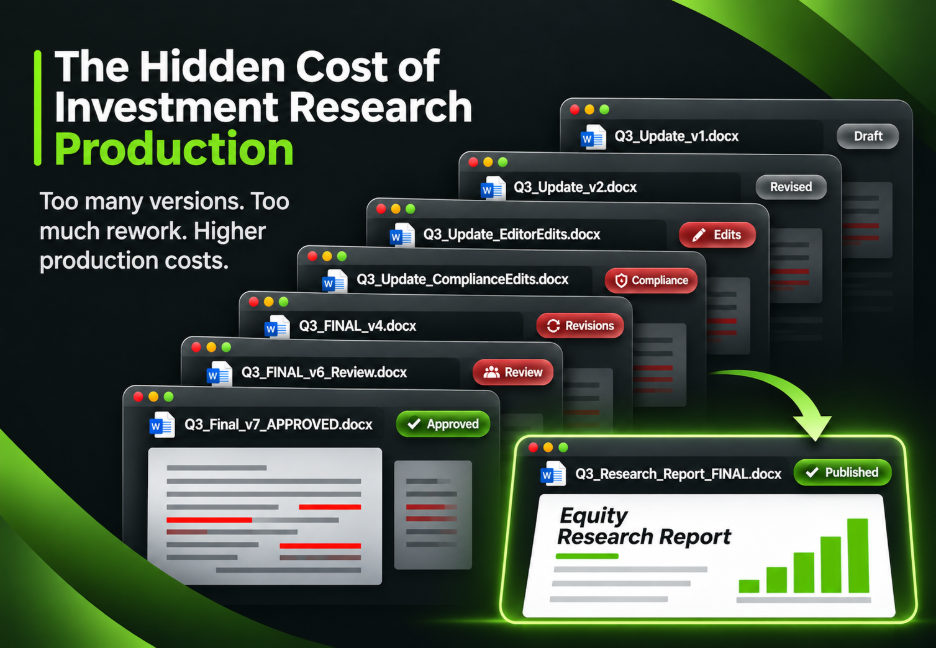
An equity research report may take days to analyse and write. Yet completing the analysis does not mean the report is ready for publication.
Financial tables need updating, charts require formatting, disclosures must be checked, and reports must pass through approval stages before reaching investors.
These activities consume time across research, compliance, operations and sales teams.
The real investment research production cost extends beyond analyst hours. It includes the people, processes and technology required to turn investment insight into an approved research product and deliver it to the intended audience.
What Does Investment Research Production Cost Actually Include?
Investment research production cost extends beyond analyst time to include the operational resources involved in authoring, reviewing, approving, publishing and distributing research.
These costs fall into four areas:
- People: Analysts, supervisors, compliance officers and production teams.
- Processes: Report preparation, reviews, revisions and approvals.
- Technology: Financial databases, document tools and publishing platforms.
- Operations: Coordination, quality checks, distribution and support.
These resources are often shared across teams and research products, making precise cost allocation difficult.
One useful management lens is the operational effort per published report, particularly the time spent on activities outside core investment analysis.
What Are the Hidden Costs of Producing Equity Research Reports?
The less visible costs of equity research production arise from duplicated work, manual handoffs, repeated checks and rework across the publication process.
Common sources include:
- Report formatting: Repeated adjustments to charts, tables, layouts and branding.
- Repeated data handling: Transferring financial estimates, valuation outputs and recurring content between models, repositories and documents.
- Review cycles: Multiple rounds of supervisory and compliance approvals.
- Compliance management: Rechecking disclosures, restrictions and document changes.
- Version management: Tracking revisions and identifying approved documents.
- Collaboration: Coordinating activities across research, compliance and sales.
- Research distribution: Preparing client communications, recipient lists and publication formats.
- Disconnected tools: Repeating tasks across separate applications.
The largest inefficiency may not be any single activity. It is often the repeated handling of the same information by different people throughout the research production workflow.
For example, a financial estimate may be updated in a model, transferred into a report, reviewed, revised and checked again before publication.
Each additional handoff creates more work without necessarily improving the underlying research.
How Do Manual Research Workflows Increase Production Costs?
Manual research workflows increase production costs by creating repetitive activities, additional coordination and longer publication cycles.
Consider an analyst preparing an earnings update. Revised forecasts may require changes to financial tables, charts, report formatting and supporting commentary.
If these activities span disconnected systems, even a minor revision can trigger further work across multiple teams.
This creates several operational consequences:
- Analysts spend more time on production tasks instead of investment analysis.
- Supervisors face additional review and reconciliation work.
- Compliance teams may need to reconcile disclosures, approval status and document changes across versions.
- Sales teams may receive approved research later than expected.
For time-sensitive research, slower publication can narrow the commercial window in which valuable analysis supports client engagement.
How Can Research Houses Reduce Equity Research Production Costs?
Research houses can reduce avoidable production effort by standardising repetitive activities, improving workflow visibility and automating appropriate parts of the publication process.
Practical improvements include:
- Standardise report templates to reduce repeated formatting work.
- Automate recurring content population using validated financial data and standard content.
- Define approval workflows with clear owners, stages and escalation paths.
- Centralise research information to reduce repeated entry and reconciliation.
- Connect final approval with distribution to reduce downstream handoffs.
- Measure workflow performance through turnaround times, rework cycles and approval delays.
The objective is to improve research productivity without compromising analyst judgement, research quality or compliance oversight.
How Does ANALEC Resonate Help Optimise Investment Research Production?
ANALEC Resonate is an investment research authoring, workflow, compliance and distribution platform designed to support the research publication lifecycle.
Its capabilities address several recurring operational cost drivers:
- Research authoring: Microsoft Office-based tools, configurable templates and automated population of financial and standard report content.
- Document consistency: Formatting and template tools supporting consistent report presentation and branding.
- Workflow management: Configurable approval stages, workflow-status visibility, date/time-stamped approvals, rework handling and audit trails.
- Compliance controls: Support for disclosures, disclaimers, compliance reviews and research-specific controls.
- Research distribution: Preference-based client delivery, branded emails, PDF/HTML formats and third-party aggregator distribution.
- Engagement analytics: Research readership and consumption insights that help firms assess how published content reaches clients.
Connecting these activities can reduce repetitive work, limit manual handoffs and improve coordination across the research production lifecycle.
Actual efficiency gains depend on existing systems, implementation requirements and workflow adoption.
Why Should Equity Research Firms Rethink Their Research Production Costs?
The investment research production cost extends far beyond analyst working hours. Repeated handling, approval delays and disconnected publishing activities can consume resources that might otherwise support research and client engagement.
Research houses should evaluate the complete publication lifecycle, not just the time required to produce investment analysis.
Explore ANALEC Resonate to see how integrated research authoring, workflow approvals, compliance controls and distribution can reduce repetitive work across research production. Contact us to discuss your research production workflow.
FAQs
1. What are the main costs involved in investment research production?
Investment research production costs include analyst time, financial data, technology, compliance reviews, report formatting, approvals and distribution. Manual processes and repeated revisions add hidden operational costs.
2. How do manual workflows increase equity research production costs?
Manual workflows increase costs through repetitive formatting, data transfers, multiple document versions and approval delays. These activities consume analyst time and slow research publication.
3. How can investment research firms reduce research production costs?
Research firms can reduce costs by automating repetitive tasks, standardising report templates, centralising data and streamlining approval workflows while maintaining research quality and compliance.
4. How does research workflow automation improve analyst productivity?
Research workflow automation reduces manual formatting, data handling and publishing tasks. This allows analysts to focus more on financial modelling, investment analysis and delivering timely research.
5. How does ANALEC Resonate help reduce investment research production costs?
ANALEC Resonate integrates research authoring, workflow approvals, compliance controls and distribution to reduce repetitive work, improve operational efficiency and streamline research publication.