
From Broad Distribution to Relevant Delivery: Why Client Research Preferences Matter
For years, equity research distribution was largely judged by reach: publish the research, build the distribution list and get it in front of as many relevant clients as possible.
That model is becoming less effective. Buy-side clients, corporate issuers and other market participants already receive significant volumes of investment research, market commentary and financial information. Sending more does not necessarily create more research engagement. In some cases, it simply adds to the noise.
The more useful question for research houses is no longer “How many clients received this?” but “Was this research relevant to the clients who received it?”
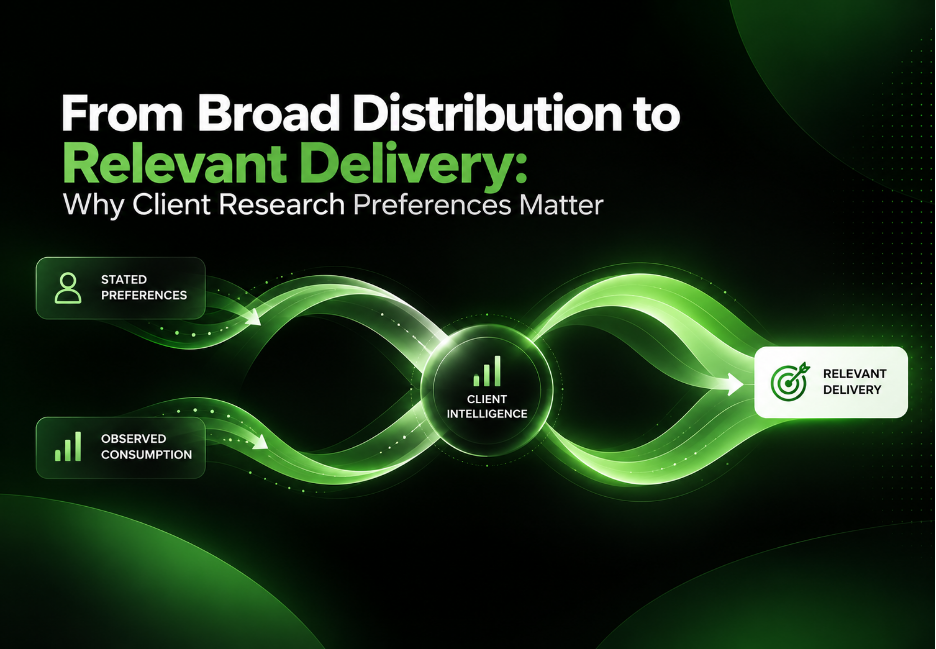
Answering that requires more than knowing what clients say they want. Research organizations need to combine stated client research preferences with observed research consumption. Together, these signals can provide stronger client intelligence and a better basis for relevant research delivery.
Why Is Broad Research Distribution No Longer Enough?
Broad equity research distribution solves a reach problem. It does not necessarily solve a relevance problem.
A portfolio manager focused on European industrials may have little reason to receive every report covering financials, healthcare or emerging-market technology. A corporate issuer may be interested in sector developments and market context rather than the same content consumed by an institutional investor.
When these differences are not reflected in research distribution, several problems emerge:
- clients receive material with limited relevance to their interests;
- useful research competes with a growing volume of unrelated content;
- equity sales and trading teams have less clarity on what may prompt a meaningful client conversation; and
- research houses can struggle to distinguish distribution volume from genuine client engagement.
Large mailing lists can create the appearance of coverage while providing limited insight into whether research is reaching the people most likely to value it.
What Are Client Research Preferences and Why Do They Matter?
Client research preferences show what a client says they are interested in and how they prefer research to be delivered. Research consumption shows what they actually engage with. Both matter.
Stated preferences can include companies, sectors, geographies, analysts, research products, delivery channels and formats. Depending on the client, timing and frequency may also influence how useful research delivery becomes.
But stated preferences provide only part of the picture.
A client may indicate broad interest in a sector while repeatedly consuming research on a smaller group of companies. Another may subscribe to several research categories but engage most consistently with thematic or analyst-specific content.
This creates an important model for modern research intelligence:
Stated preference + observed consumption = stronger client intelligence.
Neither signal should automatically override the other. A single unopened report does not prove a lack of interest, just as an old preference should not be treated as permanently accurate. Used together over time, preference and behaviour data can give research houses a more informed view of what is relevant to each client.
Who Benefits From Better Research Preference Intelligence?
Preference intelligence affects both the external consumers of equity research and the internal teams responsible for creating, distributing and commercializing it.
The distinction matters. Buy-side clients and corporate issuers are research consumers. Research analysts, equity sales and trading teams and distribution functions sit on the provider side and need intelligence that helps them serve those audiences more effectively.
Preference intelligence therefore has value on both sides of the research relationship: clients receive greater relevance, while providers gain a clearer basis for deciding what to distribute and to whom.
How Can Research Houses Combine Preferences and Consumption Data?
Moving toward relevant research delivery requires more than creating smaller email lists. Research houses need a repeatable process that connects stated interests with actual client behaviour.
A practical approach is to:
- Capture stated preferences across relevant sectors, companies, geographies, analysts, research products and delivery choices.
- Use those preferences to inform distribution rather than relying solely on broad client categories or historical mailing lists.
- Observe subsequent research consumption to understand which content clients actually engage with.
- Compare preference with behaviour to identify consistent interests, changing patterns and potential gaps.
- Refine targeting over time as client mandates, responsibilities and areas of interest evolve.
Data quality remains critical. Preferences lose value when they become outdated, fragmented across systems or dependent on individual salespeople maintaining manual lists.
Consumption data also needs context. A client failing to open one report does not necessarily indicate a lack of interest. Timing, channel and workload can all affect engagement. The objective is not to turn every click into a conclusion, but to build a stronger picture of client behaviour over time.
How Can Resonate Help Turn Client Preferences Into More Relevant Research Delivery?
This is where Resonate by ANALEC fits into the changing research distribution model.
Resonate is designed to help research organizations manage client research preferences and connect them with research distribution and engagement intelligence. ANALEC’s product materials describe preference management across research products, company coverage, sectors, countries and analysts, alongside preferred research delivery modes.
Importantly, those preferences can become part of the distribution workflow. Once research receives final approval, saved client preferences can inform who receives the content and how it is delivered. Subsequent readership and consumption can then be tracked, giving research organizations another signal about actual client engagement.
This creates a more useful cycle than distribution alone:
What clients say they want informs delivery. What they subsequently consume adds another layer of intelligence.
For research analysts and equity sales and trading teams, that can provide a clearer understanding of client interests. For distribution teams, it creates a more structured basis for personalized research delivery without treating every recipient as part of the same audience.
Technology does not remove the need for discipline. Preferences change, client data requires maintenance, and distribution and access controls remain part of the research workflow. The value comes from making preference and consumption intelligence part of an ongoing process rather than a one-time segmentation exercise.
What Will Define More Effective Equity Research Distribution?
The future of equity research distribution is not simply about reaching more people. It is about learning continuously from the relationship between client interest and client behaviour.
That means moving beyond distribution as the final step in the research process. A client’s stated preferences can inform initial delivery; subsequent consumption provides evidence of engagement; that behaviour enriches client intelligence; and the resulting insight can improve future targeting.
For research houses, the model becomes a continuous feedback loop:
Preference → Distribution → Consumption → Intelligence → Better targeting.
ANALEC Resonate provides infrastructure to support that cycle, helping research organizations connect what clients say they want with what they actually consume and use both signals to make the next research interaction more relevant.
FAQs
1. What are client research preferences in equity research?
Client research preferences indicate the investment research a client is interested in and how they prefer to receive it. These preferences can cover companies, sectors, geographies, analysts, research products, formats and delivery channels. When combined with observed research consumption, they can give research houses a stronger understanding of actual client interests.
2. Why are client research preferences important for research distribution?
Client research preferences help research houses move beyond broad distribution lists toward more relevant research delivery. Instead of sending the same content to large audiences, distribution can be informed by what individual clients or client groups have indicated they want to receive. This can reduce irrelevant communication while making research engagement more meaningful.
3. What is the difference between stated research preferences and observed research consumption?
Stated preferences show what clients say they want; observed consumption shows what they actually engage with. A client might express interest in an entire sector but consistently read research on only certain companies or themes. Looking at both signals provides richer client intelligence than relying on either one alone.
4. How can research houses use research consumption data to improve targeting?
Research houses can compare consumption patterns with existing client preferences to identify areas of consistent interest, changing behaviour and potential gaps in targeting. Consumption data should be interpreted over time rather than treating individual opens or non-opens as definitive signals. The resulting feedback loop is Preference → Distribution → Consumption → Intelligence → Better targeting.
5. How does ANALEC Resonate support more relevant equity research delivery?
Resonate by ANALEC helps research organizations manage client research preferences and connect them with distribution and engagement intelligence. Saved preferences can inform research distribution after content receives final approval, while subsequent readership and consumption can be tracked. This allows research houses to connect what clients say they want with what they actually consume and use those signals to inform future targeting.